
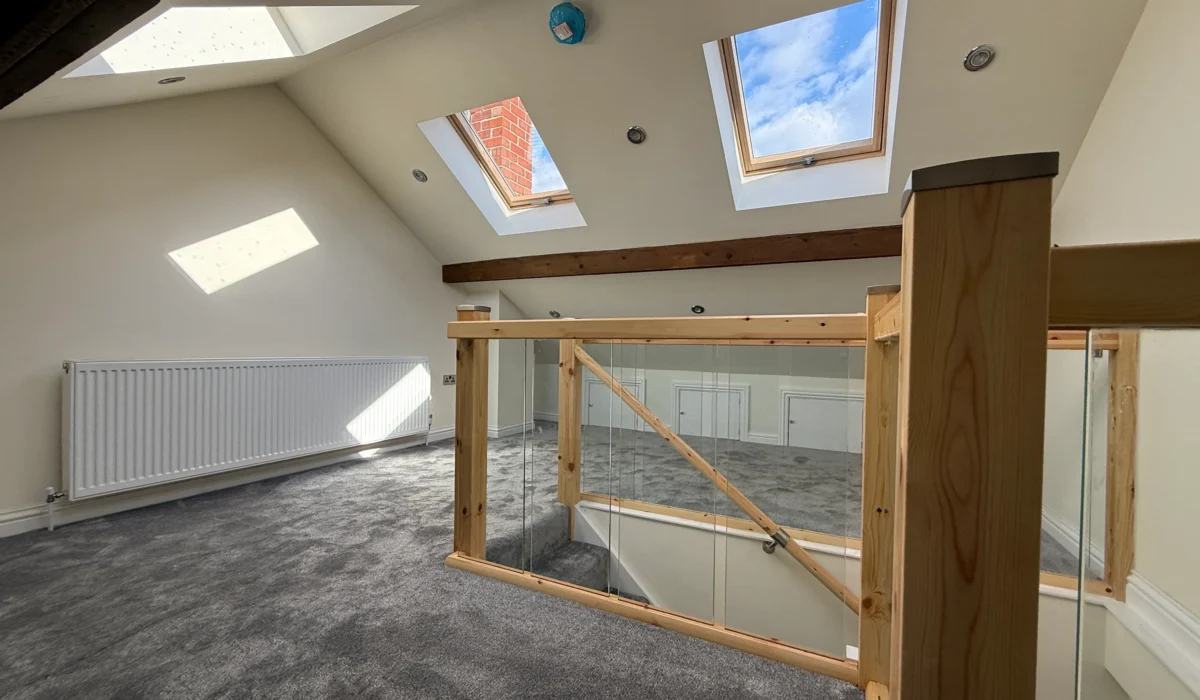
Thousands of Sheffield homeowners are sitting on untapped living space without knowing it. If you’ve ever wondered whether your attic could become a proper room, here are the five signs that your home might be ready and what the process looks like from assessment to completion.
Sign 1: You Have Sufficient Head Height
The single most important factor in whether your attic is suitable for conversion is head height. Building regulations require a minimum floor-to-ceiling height of 2.2 metres in a habitable room, measured at the highest point. For most practical purposes, you want at least 2.4 metres to make the space feel comfortable. The easiest way to check is to measure from the top of your ceiling joists (the floor of your attic) up to the underside of the ridge beam at the apex of your roof. If that measurement is 2.2 metres or more, you’re likely in good shape. Designed to Build will take precise measurements and confirm suitability during a free assessment.
Sign 2: Your Roof Has a Suitable Pitch
Roof pitch the angle of the slope affects both head height and the amount of usable floor area in your converted loft. A pitch of 30 degrees or more generally gives you sufficient head height over a reasonable floor area. Many Victorian and Edwardian terraces in Sheffield, as well as 1930s semis, have pitches of 40 to 45 degrees, which are excellent for conversion. Flatter roofs (below 25 degrees) may require a dormer extension to create adequate space, while very steep pitches (above 50 degrees) are uncommon in residential Sheffield but would provide exceptional head height. A visual check of your roofline from the street will give you a rough idea, but only a professional survey provides a definitive answer.
Sign 3: Your Roof Timbers Are in Good Condition
Older properties occasionally have roof timbers affected by woodworm, wet rot, or previous poorly executed work. Before any conversion can proceed, a structural engineer will assess the condition of the existing timbers and specify any remedial work needed. In most cases, the existing structure can be retained and augmented with new steel work but catching any issues at survey stage prevents nasty surprises mid-build.
Sign 4: You Have Viable Access
A habitable loft room needs a proper staircase, not just a loft ladder. Building regulations specify minimum staircase dimensions including tread depth, riser height, handrail requirements, and headroom clearance. This means you need enough space on the floor below to accommodate a staircase run, typically between 2.5 and 3.5 metres of floor length depending on the rise. In many Sheffield terraces, the landing at the top of the existing staircase can be extended into the attic space without sacrificing a full bedroom below — but this requires careful planning. Designed to Build will identify the best staircase position during the initial assessment.
Sign 5: Your Property Isn’t in a Restricted Zone
Most standard attic conversions fall within permitted development rights meaning no planning application is required. However, if your home is in a conservation area (several exist in Sheffield, including Broomhall, Endcliffe, and parts of Ranmoor), is a listed building, or is a flat rather than a house, different rules apply and planning permission will be needed. Similarly, if your property has already used its permitted development allowance for previous extensions, any new work may trigger a planning application. This is something Designed to Build checks as a matter of course before any project begins.
What to Expect Once You’ve Decided to Go Ahead
Once suitability is confirmed, the process typically runs as follows: structural engineer drawings are produced, building regulations approval is obtained, and a start date is agreed. The build itself involves installing a structural steel framework, laying the floor, framing the new walls and ceiling, installing insulation, roofing works (Velux windows or dormer), fitting the staircase, first and second fix electrics, plastering, and decoration. Most standard conversions in Sheffield are complete within six to eight weeks. Designed to Build manages every stage of this process, from the first survey to the final building control sign-off, with a single point of contact throughout.