
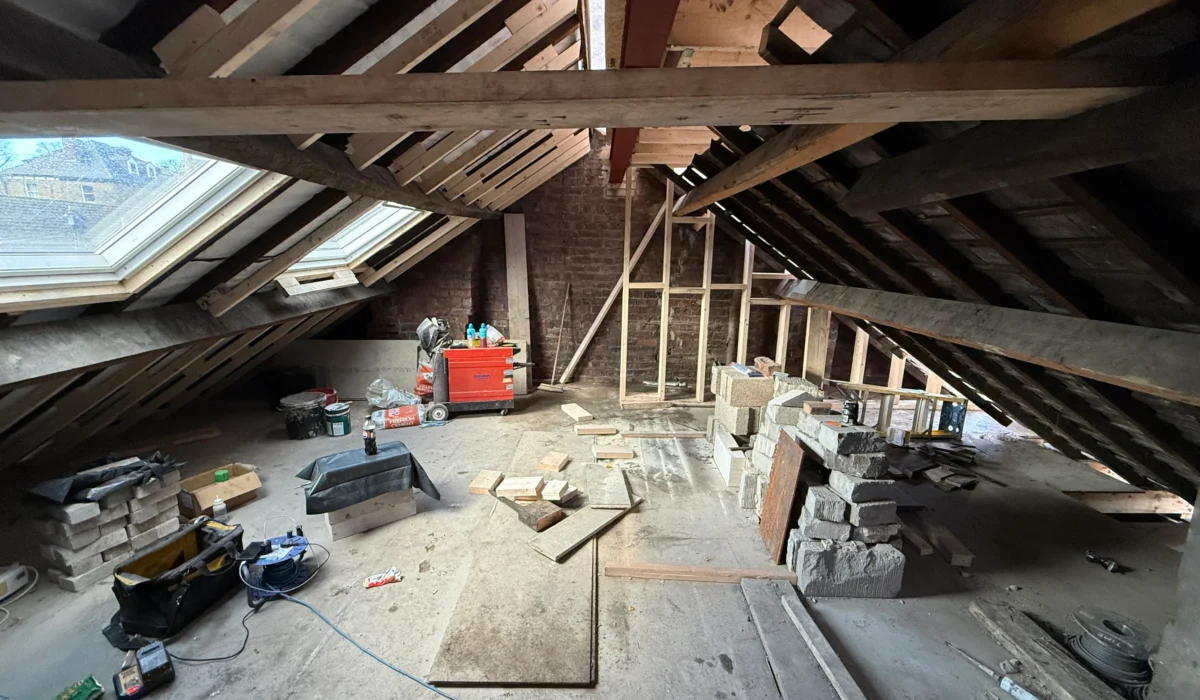
Not everyone who looks up at their loft hatch needs a full conversion. Sometimes what you actually need is safe, properly raised loft boarding: storage you can walk on without crushing your insulation or putting a foot through the ceiling below.
This guide explains the difference between loft boarding and a loft conversion, what each one costs, and how to decide which is right for your home
Loft boarding and loft conversions are two completely different jobs
It’s easy to lump them together. They both happen in the roof space, both involve floors, and both make the loft more useful. But the work involved, the cost, and the end result are nothing alike.
Loft boarding is the installation of a raised floor over your existing roof joists. It creates a stable, walkable platform for storage while preserving the insulation underneath. Your loft becomes safe, accessible, and genuinely useful, but it stays a loft. It is not habitable space.
A loft conversion transforms the roof void into a room: a bedroom, home office, or bathroom. That means structural work, full insulation to building regs, plasterboard, electrics, lighting, heating, windows, and a proper fixed staircase. It’s a building project, not a storage upgrade.
If you only need somewhere to put the Christmas decorations, the suitcases, and the box of baby clothes you can’t quite throw out, you need boarding, not a conversion.
When loft boarding is the right answer
Loft boarding is the right call when:
- Your main problem is storage, not space to live in
- You want to free up bedrooms, the garage, and the cupboard under the stairs
- Your loft’s head height is too low for a habitable room (under ~2.2m at the highest point)
- The roof pitch is too shallow for a conversion to make sense
- You don’t want to spend £15,000+ or live through weeks of building work
- You want the job done in 1 to 2 days, not 6 to 8 weeks
A huge proportion of UK homes, particularly older terraces and semi-detached properties, simply don’t have the height for a conversion to be worth doing. Boarding turns that same space into something genuinely useful for a fraction of the cost.
Why DIY loft boarding usually backfires
The single most common mistake we see is boards laid directly onto the joists, flat on top of the insulation.
Modern building regs require around 270mm of loft insulation. Most joists are only 100mm deep. If you board straight onto the joists, you compress that insulation down to 100mm, losing more than half its thermal performance and pushing up your heating bills every winter.
A professional raised loft boarding system sits on plastic legs (LoftZone, LoftLeg or similar) that lift the boards 170 to 250mm above the joists. The insulation stays at its full depth. The boards stay solid underfoot. You get storage and a warm house.
What a proper loft boarding job includes
A complete loft boarding installation from Designed to Build covers:
- Raised boarding system over your insulation, not crushing it
- Tongue-and-groove chipboard flooring rated for storage loads
- Loft hatch (new or upgraded, insulated and draught-sealed)
- Fitted loft ladder so the space is actually usable
- LED loft lighting with a switch at the hatch
That turns a dark, awkward void you avoid into a bright, organised extension of your home.
When a full loft conversion makes more sense
A conversion is the better long-term call when:
You’re planning to sell in the next few years and want to maximise value
You need more living space, not just storage
Your roof has head height of at least 2.2m at the highest point
You’re growing the family and need another bedroom
You work from home and need a dedicated office
An extra bedroom or home office adds significantly more to a property’s value than storage space does, typically 15 to 20% to the asking price. The investment is bigger, but so is the return.
Can you board the loft now and convert later?
In most cases, yes. Boarding your loft now doesn’t stop you converting it down the line.
The caveat: it’s worth having a specialist check whether your roof structure and head height are even suitable for a future conversion before you spend money on boarding. There’s no sense doing work now that will need to be ripped out in three years.
Designed to Build can assess both options in a single visit, so you know exactly which path makes sense for your home before you commit a penny.
Loft boarding cost vs loft conversion cost
| Factors | Loft boarding | Loft conversion |
|---|---|---|
| Typical cost | £700 to £1,800 | £15,000 to £45,000+ |
| Time on site | 1 to 2 days | 6 to 10 weeks |
| Planning permission | Not required | Usually permitted development, but check |
| Building regs | Not required | Required (structural, fire, insulation) |
| Adds property value? | Modest | Significant (often 15 to 20%) |
| Creates living space? | No | Yes |
Loft boarding cost typically ranges £700 to £1,800 depending on loft size, ease of access, and whether you’re upgrading the hatch and ladder.

Sophian
Sophian Khan has over seven years of experience in the construction and property industry, working across both private residential and commercial projects. During this time, he has built practical experience dealing with the different requirements, challenges and expectations that come with delivering work across a range of property types. His experience spans projects for private homeowners as well as commercial properties, giving him a broad understanding of how construction projects need to be planned, coordinated and delivered in different environments. This experience has helped him develop a practical approach focused on understanding the property, identifying what needs to be achieved and ensuring work is carried out to a high standard. At Designed to Build, Sophian brings this experience into each project, working closely with clients throughout the process. His knowledge comes from years of real-world involvement in construction projects rather than simply theoretical knowledge, allowing him to understand many of the practical issues that can arise during building, renovation and property improvement work.
3 Comments